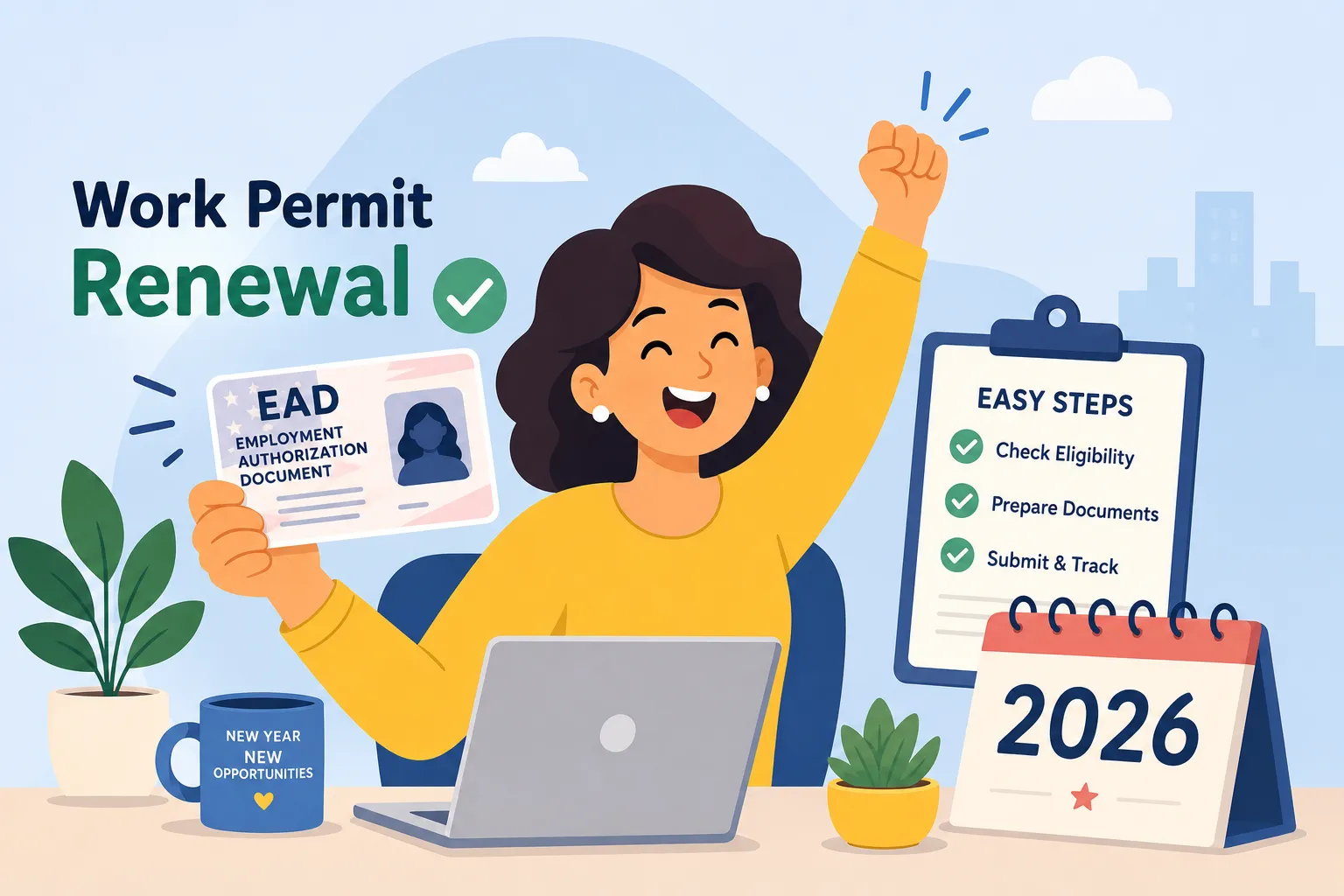
Missing your work permit renewal (EAD renewal) deadline does not just mean extra paperwork. It means you lose the legal right to work. Once an EAD expires and no automatic extension or other authorization applies, the card no longer authorizes employment, employers cannot lawfully continue the employee in paid work, and no amount of explaining to HR closes that gap. This is a compliance problem, not an administrative inconvenience.
What makes 2026 different is that several policy changes have revised how the automatic extension rules work and which categories still qualify. If you filed a renewal two years ago and assume the same rules apply today, you are working from outdated information. This guide covers exactly what you need: when to file, which documents to gather, what fees apply, how to submit, and what your options are if your card expires before USCIS decides your case.
HR professionals managing a team of foreign-national employees should note: tracking these deadlines manually across multiple workers and categories is where serious compliance gaps develop. A single missed deadline creates legal exposure for the entire organization, not just the individual employee. Izypaper is designed to address that risk at scale, with automated renewal alerts and timestamped compliance records built for HR audit readiness.
When to start your work permit renewal process
The 180-day filing window you cannot ignore
USCIS allows you to file Form I-765 for renewal up to 180 days before your current card expires. For many categories, you cannot file earlier than that window. Waiting until the final few weeks is a serious mistake given that processing times now stretch well beyond 90 days for many eligibility categories.
The 180-day window is a calendar discipline, not a suggestion. Set your filing target date the moment you receive a new EAD. If your card expires on December 31, your earliest filing date is July 4. Mark it, prepare early, and submit as soon as the window opens.
How the 540-day automatic extension works in 2026
If you file a timely renewal and your category qualifies, you can continue working past your card's expiration date while USCIS processes your application. This protection, known as the automatic extension, currently reaches up to 540 days for qualifying categories. The extension begins on your card's expiration date and ends when USCIS issues a final decision or the 540-day period runs out, whichever comes first.
The 2026 qualifying categories include A03, A05, A07, A08, A10, A12, A17, A18, C08, C09, C10, C16, C19, C20, C22, C24, C26, and C31. Categories not on this list, including A31 and several others previously included in broader summaries, are no longer covered. If your category is not on the current list, your work authorization ends on the card's expiration date, with no grace period. Verify your eligibility code against the USCIS automatic-extension policy before assuming continued work authorization.
Work permit renewal: documents required by category
Core evidence every applicant needs
Every renewal applicant submits Form I-765, a copy of the front and back of the most recent EAD, two passport-style photos, and a government-issued identity document if no prior EAD was issued. Keep these ready before you start the application, whether filing online or by mail.
Category-specific proof: what USCIS wants for your situation
The evidence you add on top of those core documents depends on your eligibility category. Adjustment of status applicants (C9) submit the I-485 receipt notice proving the pending case; they do not need to include I-94 or passport copies for this category specifically. TPS applicants include current TPS registration records and USCIS approval notices. Asylum-based filers (C8) attach the I-589 receipt notice or a stamped copy of the filed I-589. DACA applicants submit the full renewal package along with proof that DACA remains in effect.
Filing fees and how to request a fee waiver
Current I-765 fee structure
Paper filing costs $520; online filing costs $470. If you filed Form I-485 with a fee on or after April 1, 2024, and that case is still pending, your I-765 fee drops to $260. Certain eligibility categories qualify for a full fee exemption. Check the USCIS I-765 instructions for your specific class code to confirm which fees apply to your situation.
Getting an I-912 fee waiver approved
File Form I-912 alongside Form I-765, by paper only. USCIS accepts three qualifying bases: receipt of means-tested public benefits, household income at or below 150% of the Federal Poverty Guidelines (for a single person in the contiguous states, that threshold is $21,870), or demonstrated financial hardship. Your packet should contain Form I-765, Form I-912, the waiver supporting documentation, and your category-specific I-765 evidence assembled in that order.
How to submit Form I-765: online vs. by mail
Filing online through your USCIS account
Log into your USCIS online account, select "File a form online," and choose Form I-765. Complete each section covering eligibility category, biographic details, and evidence uploads. Upload passport-style photos as JPEG or PNG files and submit supporting documents as clear scans or PDFs. Pay through the USCIS payment portal and electronically sign before submitting.
One critical caution: do not file online if you have already mailed the same application. USCIS denies duplicate filings, and the filing fee is not refunded on a denied duplicate. There is no easy way to reverse that outcome once it happens.
Sending a paper packet by mail
Download the current Form I-765 PDF, complete it in black ink, and sign by hand. Assemble your supporting documents as photocopies. Mail everything to the USCIS address listed in the form instructions for your specific eligibility category. There is no single universal mailing address; the correct location depends entirely on your category and filing situation.
Processing timelines and what to do if your EAD expires first
How long does USCIS take by category in 2026?
Processing times vary significantly depending on your eligibility class and the service center handling your case. F-1 OPT filers at SCOPS are currently seeing 4 to 6 months. H-4 EADs filed with an I-539 run 6.5 to 10 months at SCOPS; standalone H-4 EADs stretch 17 to 18.5 months. Asylum-based C8 cases range from 3.5 to 17 months. Adjustment-of-status C9 cases at the National Benefits Center are running 11 to 15 months. Always check the USCIS processing times tool for your specific service center, because these figures shift regularly.
Your options when the card expires before the renewal arrives
If your category qualifies for the automatic extension and you filed on time, you can continue working and present the extension documentation to your employer. The employer records this combination: your expired EAD plus the I-797 receipt notice confirming the timely-filed renewal.
If your category does not qualify for an automatic extension, work must stop the moment the card expires. From that point, your practical options narrow to two: submit an expedite request to USCIS citing severe financial loss, USCIS error, or a qualifying humanitarian need (each ground requires supporting documentation and approval is discretionary), or consult an immigration attorney to evaluate whether any alternative employment authorization basis exists. To illustrate the stakes: a C8 asylum-based renewal filed 90 days before expiration and processed over 12 months produces a significant employment gap if the automatic extension does not cover your situation. That timeline math is precisely why the 180-day filing window exists.
What determines your outcome
The non-negotiable steps are clear: file your work permit renewal 180 days before expiration, assemble the correct evidence for your specific eligibility category, and confirm whether your category qualifies for the 540-day automatic extension before assuming your employment authorization continues past the card date. Assumptions cost work authorization.
With 2026 policy changes in effect, treating last year's rules as current guidance is exactly where costly mistakes originate. The automatic extension category list is narrower than it was, processing times are longer across several major categories, and the fee structure has changed for certain pending adjustment applicants. None of this is complicated once you have the right information in front of you.
Work permit renewal at scale: how Izypaper supports HR teams
For HR professionals, the calculus is different in scale. Tracking one renewal is entirely manageable. Tracking a team of 15, 50, or 200 employees spread across C8, C9, C26, TPS, and DACA categories, each with different expiration dates and filing windows, is where manual spreadsheets break down and legal exposure accumulates. Izypaper's platform automates renewal alerts months in advance and produces timestamped compliance records designed for audit readiness, reducing the deadline risk that creates employment gaps and organizational liability. HR teams looking to manage work permit renewal compliance at scale can contact Izypaper to learn more about implementation.
Frequently asked questions
How long can I keep working after I file my work permit renewal?
If your eligibility category qualifies for the automatic extension and you filed on time, you may continue working for up to 540 days past your card's expiration date while USCIS processes your application. Categories not on the 2026 qualifying list receive no automatic extension; work authorization ends on the expiration date shown on the card.
Can I expedite my work permit renewal?
Yes, but USCIS grants expedite requests at its discretion. Qualifying grounds include severe financial loss, a qualifying humanitarian situation, and clear USCIS error. Each request must be accompanied by documentation supporting the specific ground cited. Expedite approval is not guaranteed, which is another reason the 180-day filing window is critical.
What is the difference between employment authorization renewal and a work permit extension?
Employment authorization renewal refers to filing a new Form I-765 before the current EAD expires to obtain a fresh card. A work permit extension, in practical usage, often refers to the automatic extension period during which a timely-filed renewal application allows continued work before the new card arrives. Both concepts ultimately depend on filing within the 180-day window and qualifying under the current USCIS rules.
Préparez votre prochain dossier sans rupture.
Vous préparez un recrutement ou suivez des salariés étrangers ? Présentez votre besoin à l'équipe pour identifier l'accompagnement adapté.
